
Ownly Pay Make Stablecoin Payments Useful in the Real World
A stablecoin payment uses a digital asset designed to maintain a relatively stable value, usually against a currency such as the U.S. dollar, to pay for goods or services. USDT and USDC are two widely used examples. Their relative stability can make them more practical for payments than highly volatile cryptocurrencies.
But holding stablecoins and spending them are different things. USDT or USDC can move between compatible blockchain wallets, while a shop, restaurant, or service provider may use a local QR or banking network and expect payment through its normal local system. Completing that payment can therefore require additional conversion, routing, and settlement infrastructure.
For example, sending 20 USDC to another crypto wallet is a stablecoin transfer. Paying for a $20 meal is different if the restaurant does not accept USDC. The customer has digital value, but the merchant has a local payment system. This is one of the key challenges stablecoin payments need to solve.
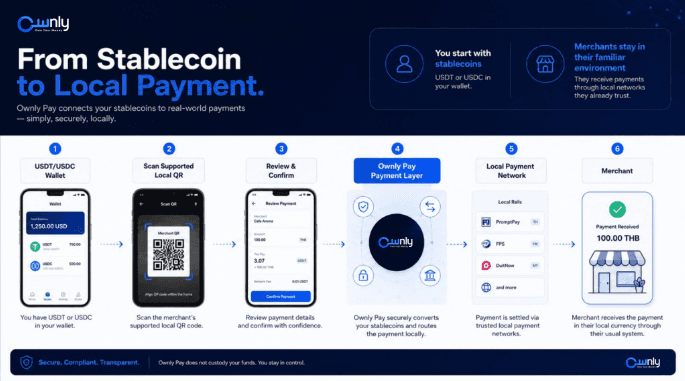
Ownly Pay is designed to connect these two environments. Instead of requiring every merchant to become a crypto merchant, Ownly Pay connects supported digital assets with supported local payment networks. The user can begin with stablecoins such as USDT or USDC while the merchant remains within the payment environment it already uses.
From the user's perspective, the experience is designed around Fund → Scan → Pay. The user holds supported stablecoins, scans a supported local payment method or QR code, reviews the transaction details, and confirms the payment. Behind that quick interaction, the infrastructure can handle the necessary payment recognition, conversion, routing, and local settlement process. Availability, supported assets, networks, limits, and payment flows can vary by market.
This distinction matters because stablecoins can be global while payments remain local. Different countries use different currencies, QR standards, banking systems, and payment networks. A user may carry the same USDT or USDC across borders, but the merchants they encounter can operate through completely different local infrastructure
It also means the merchant does not necessarily need to receive cryptocurrency. In an infrastructure-mediated payment, the customer's funding asset and the merchant's settlement environment can be different. The customer can start with supported stablecoins while the merchant receives payment through a supported local payment system.

This is particularly relevant for travelers, remote workers, freelancers, and crypto-native users. Their digital assets can move globally, but everyday expenses—coffee, restaurants, transport, shopping, and services—still happen through local payment environments. The opportunity is therefore not simply to make stablecoins transferable across borders, but to make that value useful after it crosses the border.
Stablecoins have made relatively stable digital value portable across blockchain networks, but portability alone does not create everyday payment utility. The next challenge is connecting that digital value with the infrastructure people and businesses already use. Ownly Pay is designed around that connection: the user holds digital value, the merchant uses local payments, and Ownly Pay connects the two where supported.